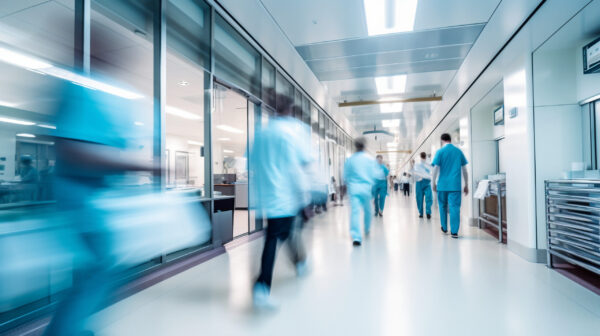
Hospitals, clinics, nursing homes and specialized healthcare facilities face the same challenge every day: protecting patients, visitors and staff while ensuring uninterrupted care, 24 hours a day.
Between constant activity, sensitive areas (operating rooms, pharmacies, medical archives), strict regulatory requirements and complex building infrastructures, ensuring security has become increasingly challenging.
How can organizations centralize the management of multiple systems—access control, video surveillance, intrusion detection, fire safety, nurse call systems and technical supervision—while maintaining a clear, consistent and responsive operational view?
This article explores the role of security hypervision for healthcare facilities, an approach that provides visibility, coordination and confidence in environments where every minute matters.
Large and Critical Healthcare Environments, Fragmented Security Systems
Modern healthcare facilities often consist of both old and new buildings, sometimes spread across multiple locations.
Central pharmacies, emergency departments, intensive care units, laboratories, patient wards and logistics areas all operate under specific security requirements.
Over the years, numerous independent systems have been deployed:
- access control
- video surveillance
- fire detection
- fire safety systems
- technical alarms (temperature, medical gases, utilities)
- nurse call systems
The problem: these systems rarely communicate with each other.
As a result:
- multiple interfaces must be monitored,
- different procedures exist across buildings,
- manual operations consume valuable time,
- and the risk of delayed response during incidents increases.
When an incident occurs in a healthcare facility, response time is critical. Yet many security control rooms must switch between three to six different software applications simply to understand the situation and react.
A Healthcare Ecosystem Under Constant Pressure
Security in healthcare extends far beyond protecting buildings.
It directly impacts:
- patient safety,
- staff protection,
- the availability of critical equipment,
- continuity of care,
- compliance with regulations (fire safety, GDPR, access management and traceability).
The reality is simple:
Complexity is increasing faster than available human resources.
Consider a typical situation.
A hospital uses one access control system for medical staff, another for contractors, a separate video surveillance platform, an independent fire alarm system and dedicated software for technical alarms.
When an incident occurs—an intrusion, a fire alarm or the failure of critical equipment—the operator must:
- identify the alarm,
- locate the affected area,
- open another application to access cameras,
- contact the appropriate response team,
- record the incident in a separate system.
This fragmented environment creates three major challenges:
- slower response times,
- limited operational visibility,
- complex and costly coordination.
This is precisely where security hypervision provides value.
Hypervision: Connecting Systems to Improve Protection
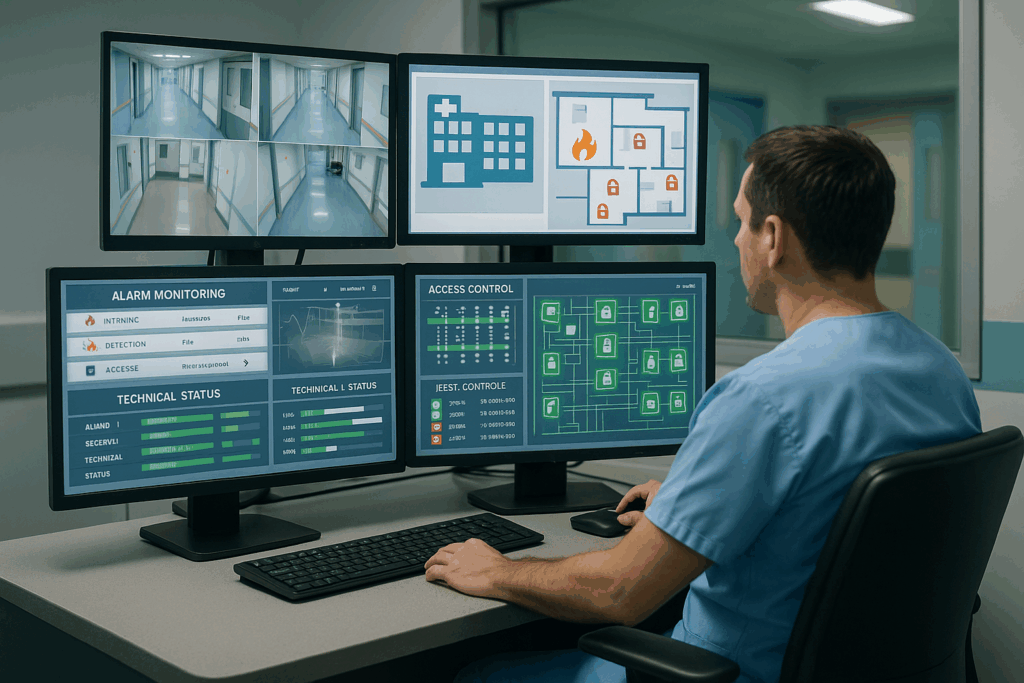
Security hypervision for healthcare facilities is a unified platform that centralizes all security and technical monitoring systems.
Rather than replacing existing solutions, it connects, synchronizes and makes them work together.
Operators can:
- monitor multiple systems through a single interface,
- correlate events (intrusion + camera + access control),
- trigger immediate actions (door locking, evacuation procedures, audio announcements),
- track every incident.
Example
A fire alarm is triggered in a recovery room.
The hypervision platform automatically:
- displays the affected location,
- opens the associated camera feeds,
- identifies emergency exits,
- recommends predefined response procedures,
- notifies the relevant response teams.
Decision-making becomes faster, more reliable and fully documented.
Practical Applications for Hospitals, Clinics and Nursing Homes
1. Centralized supervision across multiple sites
Healthcare organizations operating several facilities can manage their entire security infrastructure from a single control room.
Interactive maps provide operators with an immediate overview of equipment status, alarms and access control across every site.
2. Protect sensitive areas
Pharmacies, imaging departments, maternity wards, clean rooms and oxygen storage areas all require enhanced protection.
Hypervision enables:
- access management,
- remote opening of secured doors,
- automatic display of camera feeds during alarms,
- execution of predefined response scenarios.
3. Improve alarm and nurse call management
Fire alarms, intrusion alarms, nurse calls, elevators and medical gas systems generate numerous notifications every day.
Hypervision filters, classifies and prioritizes these events according to predefined operational rules.
4. Correlate information for better decision-making
The platform automatically connects:
- intrusion + video surveillance,
- fire alarm + evacuation procedures,
- technical alarms + sensitive areas,
- access events + personnel presence.
This contextual intelligence enables faster and more accurate decisions.
5. Ensure complete traceability
Every action is recorded:
- access events,
- alarms,
- operator decisions,
- interventions,
- automated actions.
This supports:
- audits,
- regulatory inspections,
- post-incident analysis.
6. Enhance existing infrastructure
Hypervision works with existing systems—even heterogeneous or legacy installations.
It extends their operational lifespan while avoiding costly infrastructure replacement.
7. Improve collaboration
Hypervision is more than a technical platform.
It becomes a collaborative hub connecting:
- security teams,
- biomedical engineering,
- technical services,
- IT departments,
- management,
- external service providers.
Everyone works from the same reliable operational information during an incident.
Towards Smarter and More Responsive Healthcare Security
Adopting security hypervision for healthcare facilities means moving:
- from fragmented monitoring to unified visibility,
- from reactive response to proactive management,
- from operational complexity to simplified decision-making.
For healthcare organizations, this results in:
- better protection for patients and staff,
- reduced operational risks,
- improved continuity of care,
- stronger internal coordination,
- more efficient maintenance,
- simplified regulatory compliance.
In environments where security directly impacts the quality of patient care, hypervision becomes a strategic operational platform.
It enables organizations not only to monitor more effectively, but above all to understand better, decide faster and protect more efficiently, every day and every night, without interruption.