To verify an alarm, a monitoring center increasingly relies on video. But the cameras installed on site still need to communicate with the monitoring center software that handles the alert.
With this in mind, Azursoft is announcing a new compatibility. Horus now supports the protocol of VIGI by TP-Link, TP-Link’s professional video surveillance range. Monitoring operators can now rely on this equipment for video alarm verification.
TP-Link and VIGI: a networking specialist expanding into video surveillance
TP-Link is first and foremost a network equipment manufacturer. Omada by TP-Link, its offering for business networks, covers routers, switches and WiFi access points. VIGI by TP-Link is its IP video surveillance line. This networking expertise directly benefits video: a unified ecosystem, designed to be easy to deploy and manage.
VIGI offers a complete range of video surveillance systems: cameras, video recorders, management software and accessories. It is aimed in particular at small and medium-sized businesses. For VIGI, compatibility with Horus opens the door to monitoring centers.
What VIGI brings to video alarm verification
Depending on the model, VIGI cameras feature built-in artificial intelligence. It detects intrusion, line crossing and loitering. The cameras also act as motion detectors. They distinguish people from vehicles, which reduces false alerts.
Processing takes place directly in the camera, in real time. This analysis limits the bandwidth used. Monitoring operators therefore receive events that are already qualified.
VIGI’s ColorPro technology also improves night vision. It delivers color images, even in very low light. For alarm verification, this is an advantage: the operator can better identify people and vehicles.
Some VIGI cameras also include a spotlight and a siren. They are triggered as soon as a person or a vehicle is detected. Compatible models also offer two-way audio, to communicate with people on site.
Attribute-based search tools complete the range. Users can quickly find a person or a vehicle in recordings. These features speed up checks after an incident.
Horus, our monitoring center software, now integrates the VIGI protocol
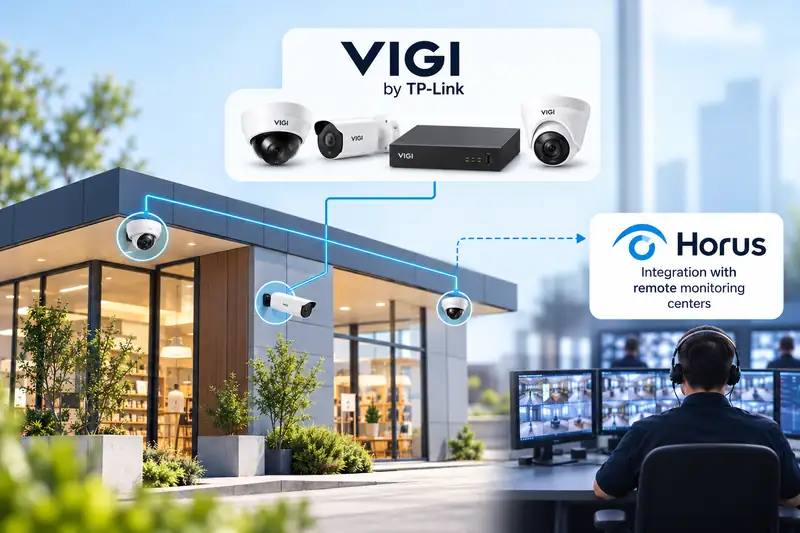
Azursoft has validated the compatibility between VIGI and Horus. This first scope covers video alarm verification. When an alarm occurs, the Horus operator can qualify the event using video streams from VIGI devices.
The alert is handled directly in Horus. Implementation does not disrupt the center’s working practices.
The VIGI protocol joins the more than 270 protocols already integrated into Horus.
What this compatibility changes for monitoring centers
For a monitoring center or station, it expands the range of video equipment that can be used. Teams can add VIGI installations to their portfolio without changing tools. They enhance their monitoring service while keeping their usual way of working in Horus.
For installers, the choice of equipment widens. They can offer VIGI devices to their customers, knowing they will be supported by their monitoring center.
Remote monitoring remains available 24/7. The operator handles the alarm in Horus, then carries out video verification in the same interface as for other integrated devices.
This compatibility with VIGI illustrates the openness of Horus. Our customers can integrate new video equipment, with no development on their part.
Denis Seguin, Sales & Marketing Director at Azursoft
For an installer, video surveillance doesn’t stop at installing cameras: their customers expect effective 24/7 monitoring. Integrating VIGI with Horus allows them to connect their sites to monitoring centers equipped by Azursoft, with no development and no change of tools on the center side. It’s a concrete argument for our partners, and one more step toward a converged network and video offering, from the camera all the way to alarm verification.
Abdi Fares, Channel Sales Director, Omada by TP-Link France