The Risk Assessment Document is a legal requirement for employers in France. It is often viewed as an administrative obligation rather than a genuine tool for improving working conditions. In many organizations, it is limited to assessing physical risks, with little employee involvement and no direct connection to broader workplace wellbeing initiatives.
Yet, when properly implemented, the Risk Assessment Document can become a strategic tool for improving employee wellbeing. It helps organizations strengthen both occupational health and the prevention of psychosocial risks.
In this article, discover how your risk assessment process can become a powerful driver for healthier and safer workplaces.
Risk Assessment: A Compliance Requirement or a Wellbeing Driver?
According to a 2019 DARES study, fewer than half of French organizations had an up-to-date Risk Assessment Document. Compliance varied depending on the employer’s perception of workplace risks:
- 37% of organizations with no identified exposure to risks had an up-to-date assessment.
- 51% of organizations recognizing one or more psychosocial risks had an up-to-date assessment.
- 63% of organizations identifying physical risks had an up-to-date assessment.
- 65% of organizations facing both physical and psychosocial risks had an up-to-date assessment.
Beyond compliance, a Risk Assessment Document is designed to identify, evaluate and prevent occupational risks, helping employers improve workplace health and safety.
Why Is the Risk Assessment Document Still Underused for Workplace Wellbeing?
Although essential, it is still often treated as a static compliance document, updated only to meet legal requirements rather than as an active management tool.
Several factors explain this:
- Limited awareness: Many organizations focus primarily on physical hazards while overlooking psychosocial risks such as stress, burnout or workload.
- A top-down approach: Risk assessments are often prepared by HR or HSE departments with limited employee participation, even though employees have first-hand knowledge of workplace conditions.
- Infrequent updates: In many companies, the document is reviewed only once a year, making it difficult to respond to evolving workplace challenges.
How Can the Risk Assessment Process Improve Workplace Wellbeing?
To become a genuine wellbeing tool, risk assessment should be part of a broader prevention strategy involving employees at every stage.
Include Psychosocial Risks in Your Risk Assessment

Risk assessments should not focus solely on physical hazards. They should also consider stress, excessive workload, internal conflicts and remote working challenges.
Some practical actions include:
- Introducing indicators to monitor psychosocial risks, such as employee satisfaction, absenteeism or wellbeing surveys.
- Conducting regular employee interviews and surveys to better understand workplace concerns and adapt preventive actions accordingly.
Engage Employees in Updating the Risk Assessment
An effective risk assessment relies on active employee participation. Employees are the first to experience workplace risks and wellbeing issues.
Examples include:
- Organizing workshops where employees can share feedback and suggest improvements.
- Implementing digital reporting tools that allow staff to report physical or psychosocial risks in real time.
This collaborative approach strengthens a shared culture of prevention throughout the organization.
Connect Risk Assessment with Workplace Wellbeing Action Plans
Risk assessment should lead to concrete actions that improve employee wellbeing. However, many organizations fail to translate identified risks into practical initiatives.
Possible actions include:
- Developing prevention plans specifically addressing psychosocial risks.
- Providing training on stress management and burnout prevention.
- Improving working conditions by creating rest areas, adapting remote work policies or promoting work-life balance initiatives.
Digitalizing Risk Assessment: A Smarter Way to Improve Workplace Wellbeing
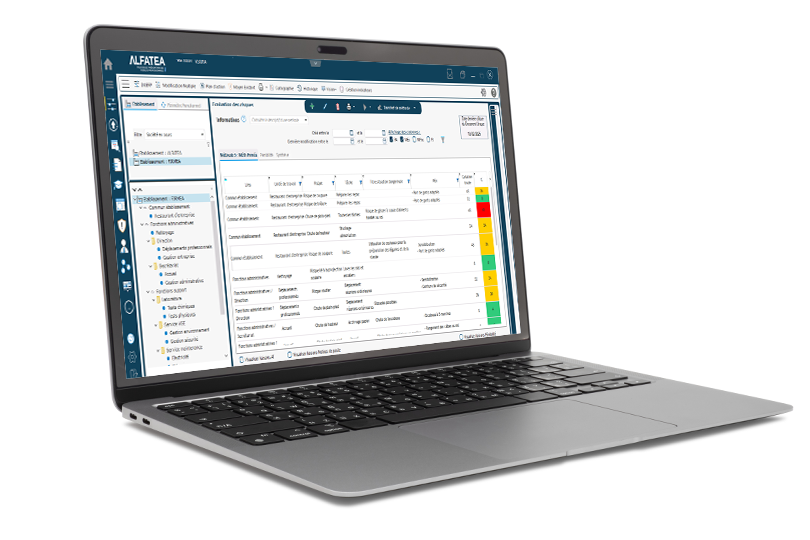
Managing risk assessments manually can quickly become time-consuming, especially when workplace conditions evolve continuously. This is where an HSE software solution such as Alfatéa makes the difference.
Why use an integrated HSE solution?
- Simplified, collaborative risk assessment updates.
- Real-time monitoring of workplace conditions.
- Planning and tracking corrective actions.
- Dashboards and reporting to analyze trends and anticipate future needs.
With Alfatéa, organizations fully integrate workplace wellbeing into their occupational risk management strategy, transforming risk assessment into a living, strategic management tool.

Discover Our HSE Software
A New Approach to Risk Assessment for Better Workplace Wellbeing
A Risk Assessment Document should be more than a legal requirement—it should become a strategic management tool for improving employee wellbeing.
By integrating psychosocial risks and involving employees throughout the process, organizations create a more effective prevention strategy. With an HSE platform such as Alfatéa, risk assessment becomes easier to manage, more collaborative and far more valuable for continuous improvement.
Improving workplace wellbeing is no longer just an ambition—it becomes a measurable, sustainable part of everyday business operations.