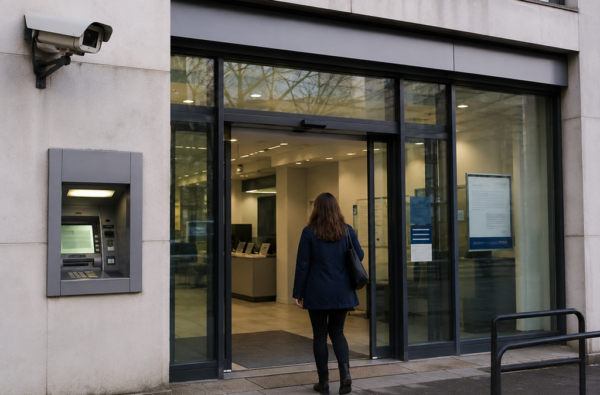
Bank security is changing fast. In France, 711 branches closed in 2025. That brought the total down to 35,711, compared with 36,422 in 2024. Fewer branches means fewer staff on site. It also means more remote advisors and more meetings outside the branch. Security now needs to cover more than just the building.
Workplace violence tells the same story. The French Banking Federation (FBF) recorded 4,932 incidents involving employees working in banking institutions in 2024. The total stayed stable, but physical assaults went up. This figure does not include mutual banking networks.
In this article: why bank security must now extend beyond the branch, what risks banks face today, and how three complementary tools can address them without a major cost increase.
Why bank security now extends beyond the branch
Digital banking has changed how customers interact with their bank. A 2022 IFOP–FBF study found:
- More than 1 in 4 French people no longer visit their branch.
- 9 out of 10 customers manage their accounts through a mobile app.
As a result, many branches now run with a single advisor instead of a team. Phone calls, video calls and secure messaging have become common ways to meet clients — often outside the branch.
Fewer colleagues on site means fewer witnesses too. Each employee is more exposed. Building protection and isolated systems are no longer enough on their own.
Three Risks Banks Face Today
Today’s banking environment brings three main types of risk.
1. Daily Incivility and Aggression
Threats, verbal abuse and aggressive behavior at the counter, or during client meetings, remain common. These incidents are often underreported. But they take a real toll on employees’ mental health.
2. Intrusions and Targeted Attacks
Criminals increasingly target ATMs, vaults and cash-handling areas. The result: financial losses, business disruption and costly equipment replacement.
3. Risks Beyond the Branch
Remote advisors and employees who meet clients off-site face new threats too. An unhappy client can turn aggressive. An advisor working alone can be pressured into revealing confidential information or approving a fraudulent transaction — with no one nearby to help.
The triple challenge for security managers
Bank security managers must balance three priorities at once:
- Protect employees — at reception, in advisory roles, or at headquarters.
- Secure sensitive areas — vaults, ATMs, cash-processing facilities.
- Keep the customer experience smooth while strengthening protection.
Doing all three well, without a big cost increase, means focusing investment on the risks that matter most.s.
How Azursoft addresses these three challenges
One single technology is not enough for a strong security strategy. Azursoft built its approach around three complementary timeframes: installation, immediate response, and long-term prevention.
Actives: Day-to-Day Site Supervision
Actives is Azursoft’s safety and security management platform. It handles daily supervision of access control, intrusion detection, video surveillance and building systems, all in one place.
In practice: when an intrusion alarm triggers, the operator can check the video footage and take control of the site’s access points, without switching screens or software. This works regardless of the equipment brand installed.

Click#SOS: a discreet alert for assaults outside the branch
Some risks appear in the moment. A customer service representative working alone, at home or at an outside appointment, has no colleagues or cameras nearby if something goes wrong.
Click#SOS was designed for exactly this situation. It sends a discreet alert, invisible to the person the employee is dealing with, straight to the remote monitoring center. As remote work has moved some risks outside the branch, protection has had to follow.
VIGI-Tools, managing incivility over time
Some risks build up slowly. Acts of incivility rarely resolve in a single moment — they accumulate, incident after incident, and place a lasting burden on staff who deal with the public.
French law makes this a compliance issue too: Article L4121-1 of the Labor Code requires employers to prevent these risks, not just manage them case by case.

One national bank network addressed this with VIGI-Tools, a web portal available to all group employees and integrated with Azursoft’s Alfatéa HSE software. The tool works in two steps:
- Resolution : the relevant department handles and closes each incident. The employee who reported it is kept informed and notified when the case is closed.
- Root-cause analysis : the data behind each incident feeds into dashboards for management, and informs prevention measures, including updates to the mandatory risk assessment document (Document Unique) where needed.
The result is a genuine improvement cycle, not just a string of one-off fixes.
Azursoft at ADITEL Forum 2026
Azursoft will attend the 35th ADITEL Forum, on September 17–18, 2026, at the Centre de Congrès de l’Aube in Troyes.
This year’s theme, “Threats to Banks 2026–2030,” lines up directly with the challenges covered in this article. The program includes a conference on threat mapping and a roundtable with representatives from UMS, CAMCA, CNPP and major banking institutions.