With 35,000 subscribers and more than 20 years of experience, Cors Online is a recognized player in the French remote monitoring market. The family-owned company mainly operates as a subcontractor for installers, who rely on Cors Online to monitor their customers’ sites. The company benefits from a well-organized certified center.
Since its beginnings, Cors Online has used our Horus remote monitoring solution. More recently, the center decided to strengthen its system by activating the AI video module integrated into Horus, in partnership with Gaard. The objective was clear: reduce false alarms, improve video alarm verification and optimize operators’ processing time.
Interview with Emilie Morel, Managing Director of Cors Online.
False alarms: a familiar challenge for remote monitoring centers
This overload has a direct impact: it slows teams down, affects processing quality and increases the burden on human resources. For Cors Online, filtering these alerts upstream became essential.
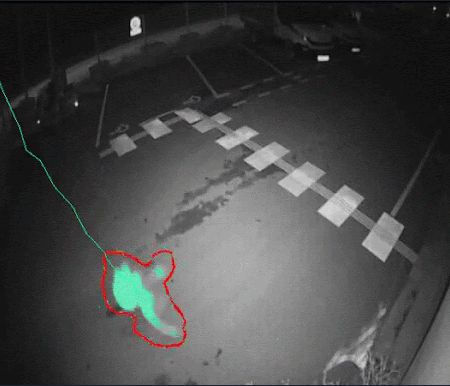
On sites such as waste collection centers or car dealerships, unwanted triggers are frequent. Moving flags, animals, thermal movements… operators receive a constant stream of false alarms. Inevitably, the higher the traffic, the lower the processing quality.
Emilie Morel, Managing Director of Cors Online
Artificial intelligence to reduce traffic and refocus teams
To address this reality, Cors Online decided to integrate Gaard’s AI, natively interfaced with Horus. The objective is simple: perform an initial automated screening of alarms, so that only relevant alerts are sent to the operator.
The system is based on real-time video analysis. The AI assigns an intrusion score to each sequence. If an alert is deemed irrelevant, it is not forwarded to the operator. Otherwise, it is presented along with the information required to make a decision.
This approach reduces the workload for operators without compromising the quality of the analysis. AI becomes a genuine support tool for managing complex video streams.
Progressive adoption driven by supervisors
For Cors Online, the success of the project relies on the involvement of its operational teams. Each supervisor, within their respective team of operators, is responsible for feeding the AI by qualifying alerts. They analyze the videos, classify them and thereby enable the algorithm to become increasingly accurate.
This approach allows for a gradual increase in processing capacity, is well accepted internally, and ensures that teams remain actively involved. Adoption took place step by step, without disrupting existing working practices.
The supervisors are the ones who use the tool. They know it well and fully engage with it because they can see that it makes their work easier.
Emilie Morel, Managing Director of Cors Online
Personalized support without disruption
The AI Video solution was implemented in close collaboration with the Azursoft and Gaard teams. Following integration, a calibration phase was used to adjust the model to the specific characteristics of Cors Online’s video streams.
This customization is key: each center has its own characteristics, its video streams are specific, and its needs are different. The AI therefore adapts to real-world operating conditions. Retraining is part of the continuous improvement process.
What’s great is that we weren’t left alone with the product. There was genuine support, particularly during the AI model labeling and retraining phase. The model was retrained using our own videos, which quickly improved performance, particularly with thermal images.
Emilie Morel, Managing Director of Cors Online
AI and remote monitoring: tangible benefits
Although the AI solution is still being progressively scaled up at Cors Online, the first results are already visible.
We have seen a 15% reduction in video traffic. That’s encouraging, especially since the tool improves over time thanks to the teams’ involvement. We’re confident that we can reach 30%!
Emilie Morel, Managing Director of Cors Online
Beyond operator comfort, AI also addresses an operational requirement: remaining compliant with quality commitments. Cors Online is an APSAD-certified remote monitoring center. It therefore cannot afford to ignore unqualified alarm triggers. However, repeatedly processing these alerts is time-consuming and can be demotivating for teams.
Sometimes we know perfectly well that it’s a flag or an animal, but we still have to process the alert. Over time, it becomes very demotivating. If AI can help us filter what we call ‘junk traffic’, all the better!
Emilie Morel, Managing Director of Cors Online
Particular attention is still paid to the accuracy of the AI’s filtering.
What worried us at first was the possibility that AI might dismiss a genuine alert. But our teams maintained close supervision during the initial phase. Our Operations Manager remains in control: they monitor, check and stay cautious. As we see that it works, confidence gradually builds.
Emilie Morel, Managing Director of Cors Online
An effective way to optimize alarm verification
For Cors Online, the benefits are clear:
- Reduced operator workload
- Fewer false alarms
- Fewer repetitive and demotivating tasks
This is what we’d been waiting for for years: a tool capable of filtering out the constant background noise that was demotivating our teams.
Emilie Morel, Managing Director of Cors Online
For Cors Online, AI helps relieve the workload on teams, who remain at the heart of the remote monitoring process. Artificial intelligence helps improve processing quality, reduce false alarms and optimize human resources, without disrupting existing practices.
With several thousand alarms processed every day — up to three per minute per operator — any support in the qualification process is valuable. Video AI is becoming a strategic tool, providing a practical response to a clearly identified operational need.
With progressive deployment, motivated teams and strong technical support, video AI is becoming a valuable tool for remote monitoring centers.