
When chemical risk prevention is discussed, the focus is often placed on hazardous substances. Companies update their safety data sheets, carry out chemical risk assessments, and implement protective measures tailored to the products in use.
These actions are essential. They help identify hazards, reduce exposure, and strengthen workplace health and safety.
However, effective chemical risk management does not depend solely on the substances present at an industrial site. It also relies on the people who handle them every day.
Even when a hazardous substance has been correctly identified, it can still present a risk. This is particularly true when employees have not received the appropriate training, certifications are no longer up to date, or personal protective equipment (PPE) is not properly monitored.
That is why the most effective organizations now adopt a more comprehensive approach to preventio, one that connects chemical risks with employee skills, equipment, and preventive actions.
Chemical Risk Prevention Goes Beyond Hazardous Substances
Chemical risk management has traditionally been based on several key elements:
- Product inventory;
- Exposure assessment;
- Chemical risk assessment;
- Implementation of preventive measures.
This approach remains essential. However, it does not always answer several critical questions faced by HSE managers.
Which employees are exposed to specific substances? Have mandatory training courses been completed? Has the appropriate PPE been issued? Have preventive actions actually been implemented?
In many organizations, this information is spread across different tools or files. Data relating to chemicals is managed in one place, while employee records, training history, and PPE tracking are maintained elsewhere.
This fragmentation makes chemical risk management more difficult and reduces the visibility required for fast and informed decision-making.
The Human Factor at the Heart of Chemical Risk Management
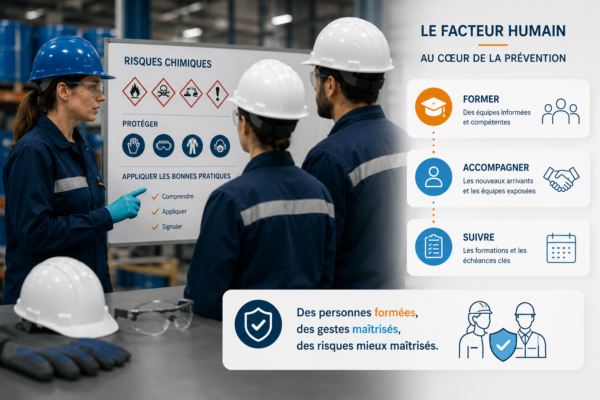
Chemical risk prevention depends as much on people as it does on products.
Even when procedures are clearly defined, their effectiveness depends on how they are applied in the field. Employees must understand the risks they face, know and follow preventive measures, and have access to appropriate protective equipment. This vigilance is especially important when several hazardous substances are handled within the same workstation. Failure to follow safety procedures or inadequate training can increase exposure and ultimately lead to workplace accidents or occupational diseases.
Monitoring safety training therefore becomes a key aspect of HSE management. Organizations must be able to quickly identify:
- Employees whose mandatory training is about to expire;
- New hires requiring specific onboarding;
- Teams exposed to particular risks.
This visibility helps reduce compliance gaps and strengthens the effectiveness of prevention initiatives.
In chemical risk management, understanding hazardous substances is essential. But understanding the people exposed to those risks is just as important.
Why PPE Traceability Matters
Personal Protective Equipment (PPE) is an essential safeguard whenever risks cannot be adequately controlled through collective protection measures.
Tracking PPE helps ensure that every employee has access to the protective equipment required for the hazards identified during chemical risk assessments.
However, simply providing PPE is not enough. Organizations must also be able to demonstrate which equipment has been assigned, to whom, and when.
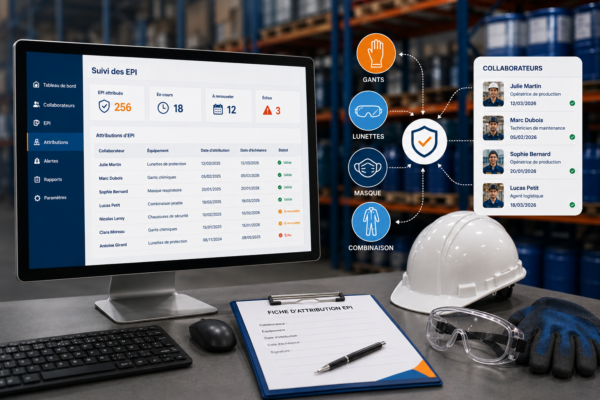
This traceability simplifies audits, improves PPE monitoring, and helps verify that the protective measures defined during risk assessments are effectively implemented in the field. In demanding industrial environments, PPE management becomes a genuine HSE management tool rather than a simple administrative obligation.
Centralizing Data to Improve HSE Management
One of the main challenges faced by HSE teams is connecting information that is often scattered across multiple systems.
Chemical inventories, training records, certifications, PPE, environmental assessments, and action plans are frequently managed separately. Yet these datasets are closely linked.
Centralization also enables the creation of dashboards that monitor key safety indicators, track action plan progress, and measure the effectiveness of preventive measures.
A centralized approach provides a clearer overview of risks and simplifies HSE management. Safety managers can access the information they need more quickly, prioritize actions, and identify key areas for improvement.
Many organizations now rely on dedicated HSE software to bring together data relating to risks, employees, and equipment within a single platform.
This approach not only saves time but also improves the quality of analysis and increases team responsiveness.
Towards a More Integrated Approach to Prevention
Chemical risks, training, certifications, and personal protective equipment should no longer be managed as separate topics.
Chemical risk prevention becomes far more effective when this information is connected through a single management and monitoring approach.
This broader vision enables organizations to better anticipate risks, strengthen regulatory compliance, and improve the management of workplace health and safety initiatives.
Companies looking to structure this approach can rely on Alfatéa HSE software to centralize the monitoring of chemical risks, employee training, and PPE within a single platform.
Today, effective chemical risk management depends not only on the substances present within an organization but also on the ability to connect the right information with the right people at the right time.